
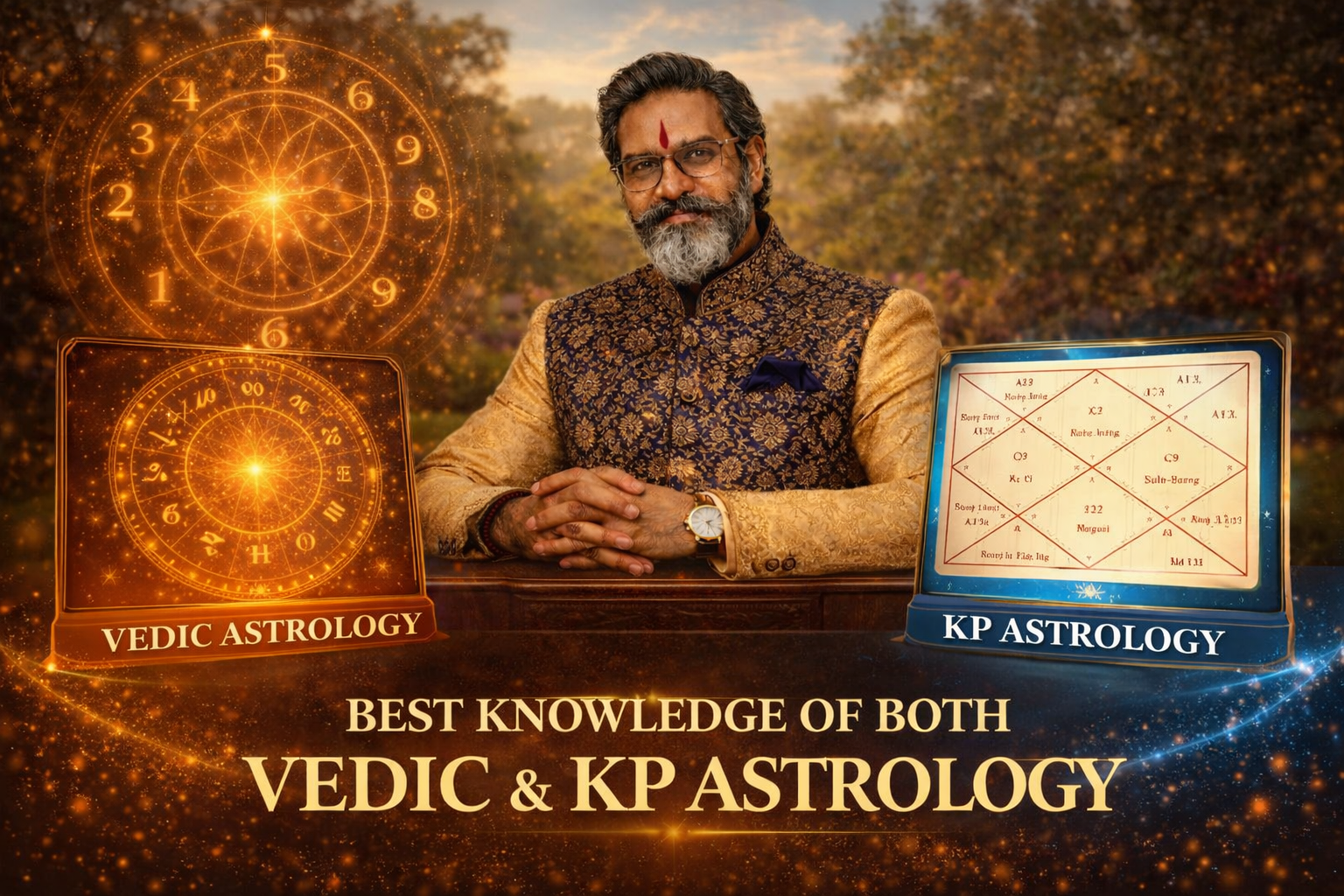
Vedic Astrology vs. KP Astrology
Which Is Better — And Why Acharya Devraj Ji Masters Both
Introduction: Two Pillars of Indian Astrological Wisdom
Astrology in India is not a single monolithic tradition. Over thousands of years, multiple schools of thought have evolved, each with its own philosophical underpinning, methodology, and area of strength. Among these, two systems stand tall and command the most serious attention from practitioners and seekers alike: classical Vedic Astrology — known as Jyotish — and Krishnamurti Paddhati, commonly called KP Astrology. The debate over which system is superior is as old as KP Astrology itself, and it continues to generate passionate discussion in astrological circles across India and the world.
This article explores the origins, principles, strengths, and limitations of both systems, examines them side by side, and sheds light on why a truly great astrologer does not choose one over the other — but commands both. Nowhere is this dual mastery more evident than in the work of Acharya Devraj Ji, one of the most respected names in contemporary Indian astrology, whose deep command over Vedic and KP systems alike has made him a sought-after guide for thousands of people navigating life's most important crossroads.
Vedic Astrology: The Ancient Science of Light
Origins and Philosophy
Vedic Astrology, or Jyotish, traces its roots to the Vedangas — the six auxiliary disciplines of the Vedas, India's oldest sacred texts. The word Jyotish itself means 'the science of light' or 'the science of the heavenly bodies,' and it reflects the ancient Indian understanding that the cosmos is not separate from human life but intimately interwoven with it. The Brihat Parashara Hora Shastra, attributed to the sage Parashara, is considered the foundational text of Vedic Astrology, and its teachings remain the backbone of the system to this day.
At its heart, Vedic Astrology is built on the concept of the Janam Kundali — the birth chart — which maps the positions of the nine celestial bodies (Navagrahas) across twelve houses and twelve zodiac signs at the precise moment of a person's birth. The system uses the sidereal zodiac, meaning it is aligned with the actual positions of stars in the sky, as opposed to the tropical zodiac used in Western astrology. This gives Vedic Astrology a strong astronomical grounding and a remarkable capacity for revealing the broad landscape of a person's karma, dharma, and destiny.
Core Strengths of Vedic Astrology
The greatest strength of Vedic Astrology lies in its philosophical depth and its capacity for holistic life assessment. Through the study of the ascendant, planetary placements, aspects, yogas (special planetary combinations), and the Dasha system — a remarkable time-lord system that divides life into planetary periods — a skilled Jyotishi can paint a comprehensive picture of a person's personality, relationships, career, health, spiritual inclinations, and life purpose.
Vedic Astrology is also uniquely powerful in its use of divisional charts (Varga charts), which allow the astrologer to zoom into specific areas of life with a degree of precision not found in most other traditions. The Navamsa (D-9) for marriage and dharma, the Dashamsa (D-10) for career, the Saptamsa (D-7) for children — these tools give Vedic Astrology an extraordinary analytical depth.
Furthermore, the system's integration with Indian spiritual philosophy — including karma, dharma, moksha, and the concept of the soul's journey across lifetimes — makes it not merely a predictive tool but a profound framework for self-understanding and spiritual growth.
KP Astrology: The Precision System of the 20th Century
Origins and Philosophy
Krishnamurti Paddhati (KP) was developed in the mid-20th century by the brilliant South Indian astrologer Shri K.S. Krishnamurti (1908–1972). Dissatisfied with the vagueness of certain predictions in traditional Jyotish — where two astrologers could look at the same chart and give different answers — Krishnamurti set out to create a system that delivered sharper, more reliable, and time-specific predictions. The result was KP Astrology, a system that blends the best elements of Vedic Astrology with a sophisticated sub-divisional technique borrowed from Western astrology.
The cornerstone of KP is the concept of the Sub-Lord — a further subdivision of the Nakshatras (lunar mansions) that creates 249 unique segments of the zodiac. Each planet occupies a Sign, Star (Nakshatra), and Sub-Lord, and it is this three-level layering — Sign Lord, Star Lord, Sub-Lord — that allows KP to achieve remarkable precision in timing events. The system also uses a unique approach to house cusps and the concept of the Significator of houses, which determines which planets will truly deliver the results associated with a given house in a person's life.
Core Strengths of KP Astrology
KP Astrology's primary strength is its precision. Where Vedic Astrology might indicate that an event will happen 'during a particular Dasha period' spanning several years, KP is designed to narrow that window down to months, weeks, or even days. This makes it particularly valuable in answering specific questions — a technique known as Horary Astrology (called Prashna in the Vedic system), where KP truly excels.
The system is also more systematic and standardized, which makes it somewhat easier to learn consistently. Its rules are clearly defined, its application is methodical, and the margin for ambiguity is deliberately minimized by Krishnamurti's design. For astrologers focused on event prediction and timing, KP is an invaluable tool.
"A Vedic astrologer sees the forest; a KP astrologer counts the trees. The master sees both."
Vedic vs. KP: A Comparative Analysis
Asking which system is 'better' is like asking whether a surgeon's scalpel is better than a physician's diagnostic manual. Both serve essential purposes, and their value depends entirely on the question being asked and the skill of the practitioner.
Philosophical Depth: Vedic Astrology wins handily. Its integration with Sanskrit literature, yogic philosophy, and karmic theory gives it a richness and spiritually resonant depth that KP, as a modern technical system, simply does not attempt to match. For those seeking to understand the deeper patterns of their soul's journey, Vedic Astrology is unmatched.
Predictive Precision: KP holds a clear edge for specific event timing. Its Sub-Lord theory and cusp-based approach to house signification produce highly pinpointed predictions that can be tested against real-world events with impressive accuracy.
Horary Astrology: KP excels in answering specific, time-sensitive questions — 'Will I get this job?', 'When will I get married?', 'Will my health issue resolve by a particular date?' — with a precision and reliability that has made it enormously popular for practical guidance.
Natal Chart Analysis: Vedic Astrology, with its rich toolkit of divisional charts, yogas, ashtakavarga, and Dasha system, offers a far more comprehensive natal analysis, revealing character, life themes, and spiritual purpose in ways that KP alone cannot achieve.
Learning Curve: KP is more standardized and in some ways more accessible for students focused on prediction. Vedic Astrology's vastness — hundreds of yogas, dozens of divisional charts, multiple Dasha systems — makes it a lifelong study that rewards deep immersion.
The wisest practitioners recognize that these systems are complementary, not competing. The ideal approach is to use Vedic Astrology's broad wisdom to understand the landscape of a person's life, and then apply KP's precision tools to answer specific questions with the clarity and timing accuracy that life's practical decisions demand.
Acharya Devraj Ji: A Master of Both Worlds
A Rare and Commanding Expertise
In the world of Indian astrology, finding a practitioner with genuine command of both Vedic and KP systems — not a superficial familiarity with each, but a deep, integrated mastery — is extraordinarily rare. Acharya Devraj Ji stands in that select group, and his reputation for accuracy, insight, and genuine guidance has made him one of the most trusted astrologers of his generation.
Acharya Devraj Ji's journey into astrology began in the traditional manner, with rigorous study of the classical Vedic texts — the Brihat Parashara Hora Shastra, Brihat Jataka, Phaladeepika, and other foundational works. Under the guidance of learned teachers, he developed a thorough grounding in the ancient system: mastery of the Dasha systems, the interpretation of yogas and arishtas, the use of divisional charts, and the application of ashtakavarga. This deep Vedic foundation gave him something that no shortcut can provide — an understanding of astrology as a complete philosophy of life, not merely a predictive technique.
Integration of KP Methodology
What sets Acharya Devraj Ji apart from many traditionally trained Vedic astrologers is his willingness and ability to embrace the precision of KP Astrology without compromising his classical foundations. He undertook a thorough study of Krishnamurti Paddhati — understanding not just the mechanics of the Sub-Lord theory, but the deeper logic that makes it work — and integrated its tools seamlessly into his practice.
The result is a consultative approach that is uniquely powerful: he uses Vedic Astrology's philosophical framework and natal analysis capabilities to understand who a person is, what karmic themes dominate their life, and what major life phases they are moving through. He then deploys KP's precision tools to deliver specific, time-anchored answers to the pressing questions that bring people to his door. This integration is not a compromise; it is a synthesis that makes both systems stronger.
Why His Dual Mastery Matters for Clients
For the people who consult Acharya Devraj Ji, his mastery of both systems translates into a consultation experience that is both deeply meaningful and practically useful. A person asking about their career, for example, receives not just a KP-based timing prediction ('you will get a new opportunity in a specific month'), but also a Vedic understanding of what kind of work is aligned with their dharma, what challenges their Saturn or Rahu may create, and what their Dashamsa chart reveals about their professional destiny. The two levels of insight — broad and specific, philosophical and practical — come together in a way that purely single-system practitioners simply cannot offer.
Similarly, for questions of marriage, health, property, spiritual growth, or business decisions, Acharya Devraj Ji's dual competency allows him to address both the 'why' and the 'when' — two questions that, when answered together, give the seeker both clarity and direction.
A Teacher as Well as a Practitioner
Acharya Devraj Ji's influence extends beyond individual consultations. He is also known as a dedicated teacher of both systems, committed to preserving and transmitting authentic astrological knowledge to the next generation. His teaching approach emphasizes that no student should treat Vedic and KP as rivals. Instead, he encourages students to master both, understanding that the two systems illuminate different facets of the same cosmic reality, and that a complete astrologer must be fluent in both languages.
This pedagogical philosophy — that breadth and depth are equally important, that ancient wisdom and modern methodology are partners rather than adversaries — is itself a reflection of his character as a scholar, practitioner, and spiritual guide.
Conclusion: Beyond the Question of 'Better'
The question 'Vedic Astrology vs. KP Astrology — which is better?' is ultimately a question that dissolves upon deeper examination. Vedic Astrology is better for understanding the soul's journey, for holistic life reading, for spiritual insight, and for grasping the broad karmic patterns that shape a lifetime. KP Astrology is better for specific event prediction, timing precision, and horary analysis. Together, they form a complete and extraordinarily powerful toolkit for understanding human life in its cosmic context.
What the debate really points to is not a flaw in either system, but a limitation in practitioners who confine themselves to only one. The astrologers who serve their clients best — who answer life's questions with both depth and accuracy, with both wisdom and precision — are those who, like Acharya Devraj Ji, have done the hard work of mastering both traditions and learning how to bring them together in service of truth.
In a field where genuine mastery is rare and the stakes for those seeking guidance are often very high — decisions about marriage, career, health, and life direction — the value of a practitioner like Acharya Devraj Ji cannot be overstated. His dual expertise in Vedic and KP Astrology is not simply a professional credential; it is a gift to all those who come to him seeking clarity in uncertain times.
"The stars speak in many languages. A true master learns them all."
— ॐ —